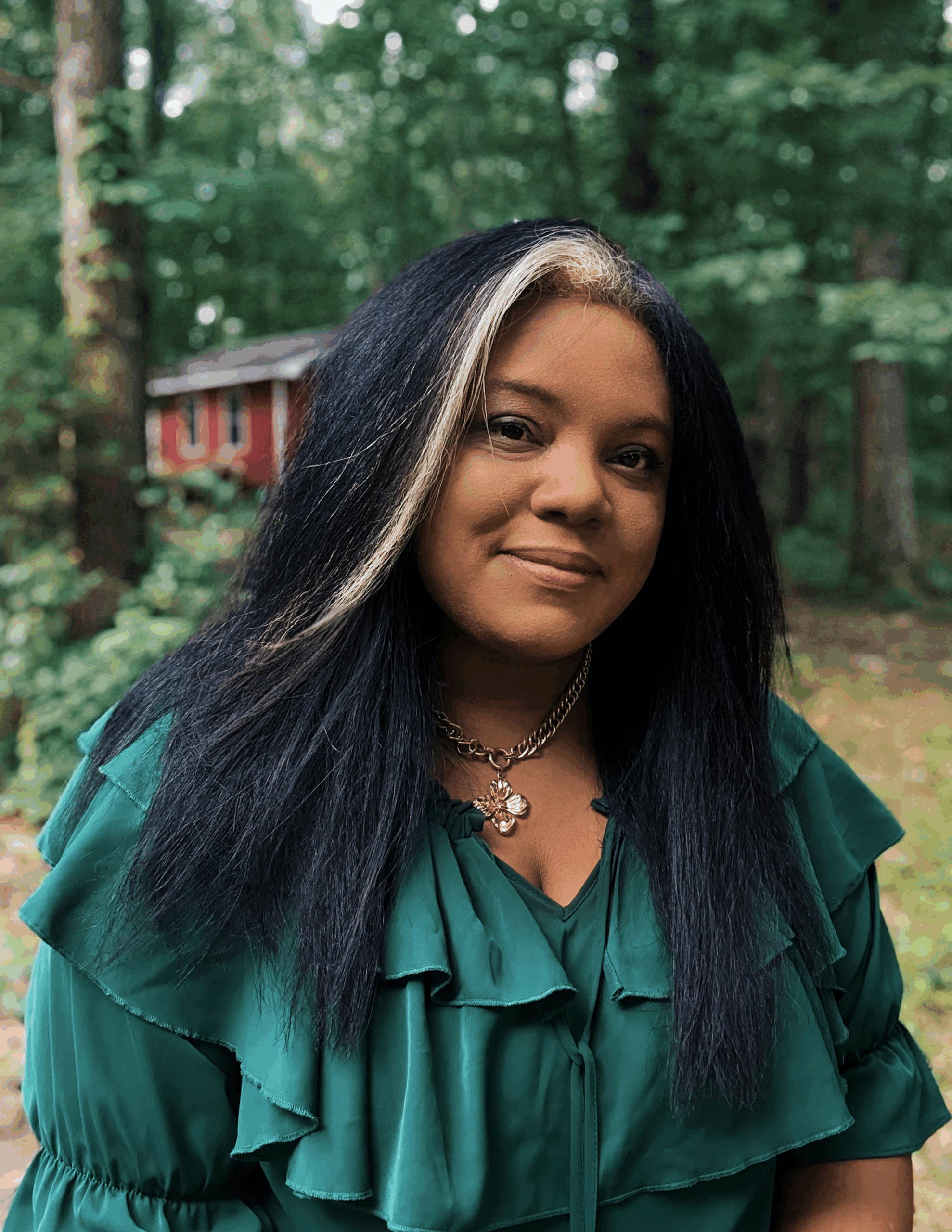
Prolific artist Morgan Harper Nichols has 1.9 million Instagram followers and a thriving creative business. This is how she built it one piece—one person—at a time, all while learning how to sustain her practice as a neurodivergent artist.
Hanging from a single clear push pin on my wall is a print that reads: “I am making the brave decision to keep going anyway.” I’ve taken it down and re-hung it every time I’ve moved over the last decade.
The handwriting on the print reminds me of the letters I used to receive in middle school; folded triangles and hearts hiding gel-penned goodness, perfect little packages passed from hand to hand.
At the bottom of this print, in the tiniest, faint pencil-like lines, is a signature: “MHN.”
The print is by the prolific artist, writer, and musician Morgan Harper Nichols.
Morgan creates art best known for inspiring and comforting the weary. Her work is imbued with the kind of hope that doesn’t disregard pain, but holds it with you. She doesn’t try to solve it or draw a smile; instead, in the midst of social media often roaring with conflict, tension, meanness, and tragedy, Morgan’s work is like someone stopping the scroll to place a cup of warm tea in your hands.
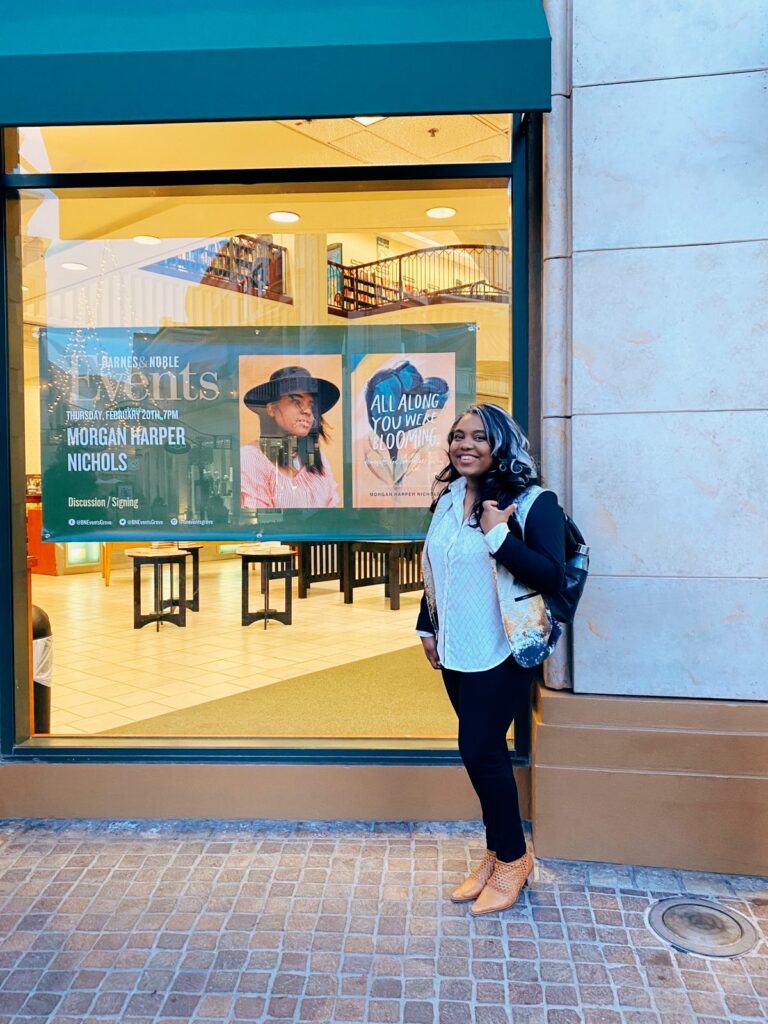
To date Morgan has 1.9 million Instagram followers and her work has led to collaborations with brands like Coach, Adobe, and Hallmark. She’s published multiple books like her bestselling art and poetry book All Along You Were Blooming, and has a popular shop called Garden 24.
Her art has been seen by millions, shared by celebrities, and grown a community she treasures. But like many artists, Morgan sustains her creativity with solitude.
A few years ago, she was diagnosed with autism, ADHD, and a sensory processing disorder. She generously shared her diagnosis online at the time, also sharing how often women and women of color have been ignored in autism research. She even shared her diagnosis on the Kelly Clarkson show, and her openness about her experiences directly led to my own autism diagnosis a few years later.
I’d always been inspired by Morgan, my laptops covered in her stickers, and I’d always hoped to profile her one day. But once I learned I was neurodivergent, profiling her felt even more urgent. At the time I reached out to her for an interview, I was in the darkest mental health season of my life, navigating a slew of unexpected losses, and plunged into a grief season unlike any I’d ever known.
Morgan’s work is all about meeting people in these exact moments: when it all really is too much. When you truly feel like you can’t keep going, she doesn’t bludgeon you with blithe promises. Her work simply turns down the volume and gives you space to remember who you really are.
“I just kept going and going.”
Morgan’s artistic career began in the aisles of her local dollar store.
Every time Morgan’s parents took her there, she bought a notebook. Piles of them could be found everywhere in her room growing up, spirally squares that taught her “how not to be afraid of the blank page.”
She remembers one of the first stories she wrote was about animals going to Six Flags. She says she wished she still had it to show me, but that sadly her eight-year-old self had decided it was a silly story and ripped it out of the notebook.
The next story she remembers writing was one her teacher commissioned the entire third-grade class to write (she was homeschooled but also attended group classes). The assignment was to write a one-page story inspired by a poster on the wall of a girl by a lake. Once they were finished, they could go outside and play.
One by one, the kids scribbled their stories onto a single sheet of lined paper and ran outside.
But Morgan wrote on a second page, then a third. In her story, the girl in the poster fell into the lake and discovered an underwater fairy world. Six pages in, the teacher said, “Ok, you’re finished now.”
“No, I’m not,” Morgan said. “I just kept going and going.”
For Morgan, the greatest form of play—and connection—is found in solitude and on the page. Notebooks were always where, she says, “the less scripted me is able to make more mistakes and lower the stakes a little bit, so I can actually learn more about who I am, what I’m actually trying to say, and how I actually want to connect with other people.”
Morgan’s early visions for her life were as open as those first empty notebooks. She eventually filled them with ideas for her life, like writing, playing music, owning a coffee shop, or having a photography studio. All she knew is that she wanted to be creative for a living.
She knew pursuing creative work would be messy and unpredictable, but she was fine with that.
She spent the years after college working in admissions while writing and recording music and doing gig work on the side. Gig work eventually became full time, but it was a heavy load of a million different things: music, graphic design, designing posters, t-shirts and album covers for bands, and doing background vocal work. “I was trying to find the thing that sticks,” she says, “that made me feel like I was seen as valuable and could pay the bills and not have to worry all the time.”
In 2016, she hit a breaking point.
“I could deal with not having the most ideal job or circumstances,” she says, “but 2016 was the moment where I became tired and broke. And that is just something you cannot sustain. I can work with broke. I can work with tired. But tired and broke together? They just do not blend well.”
“That wasn’t something I talked about.”
By 2016, Morgan felt like she’d been piecing together gig work for over 10 years and had “nothing to show for it.” She’d always thought eventually she’d “get” somewhere, but after 10 years she looked around and it felt like nothing had changed. “I was worried all the time, stressed all the time; I didn’t know what was next, and I was so anxious. I just didn’t know what to do. It all felt like wasted time.
“There are points where you’re working hard and you know it’s working towards something. But when you get to a point where you’re like, wait I’ve been saying that for a decade though. What do I do with that?”
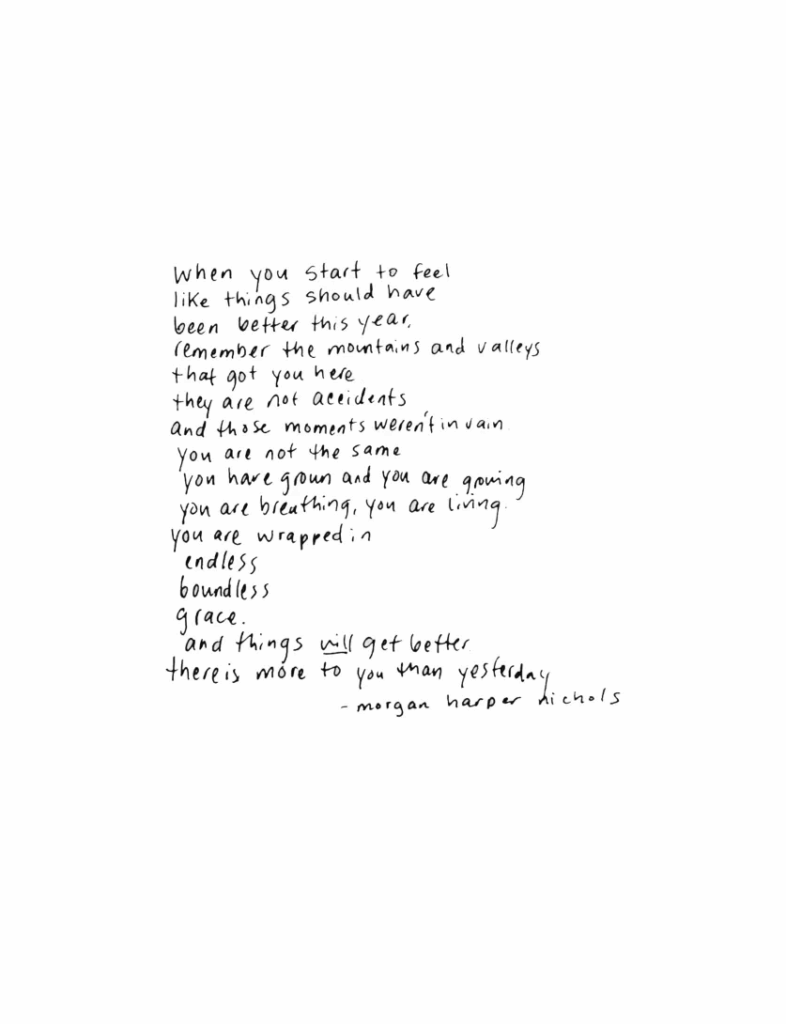
What Morgan did was write a poem. In a notebook.
She felt the impulse to share the poem, more as a way to release it because it felt heavy. But she did not want to share it on Instagram or anywhere her friends or family would see. What about Pinterest? That, she thought, seemed like a nice, quiet, anonymous place to share. She took a picture of her notebook and pinned it.
“It was the most vulnerable thing I’d put on the page at that point,” she says, “especially writing about feeling like a failure. That wasn’t something I talked about.”
She originally planned to keep it truly anonymous. But for some reason, “at the last second,” she says, “I decided to write my name on it. You can see it looks really weirdly placed, and that’s because it was a last-minute decision.”
And that decision changed her life.
“It’s that very fear that is connecting with people.”
A few months later, some people DM’d her to let her know that a celebrity had shared her poem on social media.
“Wait,” Morgan remembers thinking, “how did this get out?”
She went back and checked Pinterest and saw it had been repinned over a hundred thousand times.
“From that moment forward,” she says, “it changed things for me. But not because it was a success. It was a turning point because of other people who began to DM me about how they felt like they had failed. That became a very sobering reminder. Here I am thinking I need to try to push out of this failure and make something of myself, but it’s that very fear—that very question—that is connecting with people.
“So from there I was like, well I guess I’ll just write about all the other stuff that’s stressing me out. And that’s sort of been my approach ever since. I’m not trying to share the answers. I don’t have them. This is me trying to work through them.”
At the time the poem went viral, Morgan was still squeaking by doing gig work as a freelance musician and graphic designer (a skill she taught herself with online courses).
She got new followers from the viral poem, but her life didn’t change much at first. It started small and slow.
“Instead of trying to make this perfect collection of artwork that I feel like is just flawless,” she says of her thinking at the time,“I’m just gonna focus on one person at a time.” In October 2017, she posted the following on her Instagram:
“Send me a DM telling me a little bit of your story in a sentence or two or something you’ve been through. I’ll create something and DM it back to you, and I’ll share it here too. I won’t include your name though, I’ll keep that part anonymous, unless you are cool with it being shared.”
The next morning she woke up to hundreds of DMs.
Her social media following was still small at that time, so she was completely surprised by the response.
She made art for one person at a time. Each person shared it. Her audience grew.
Then her business grew.
“Can you turn this into a sticker?”
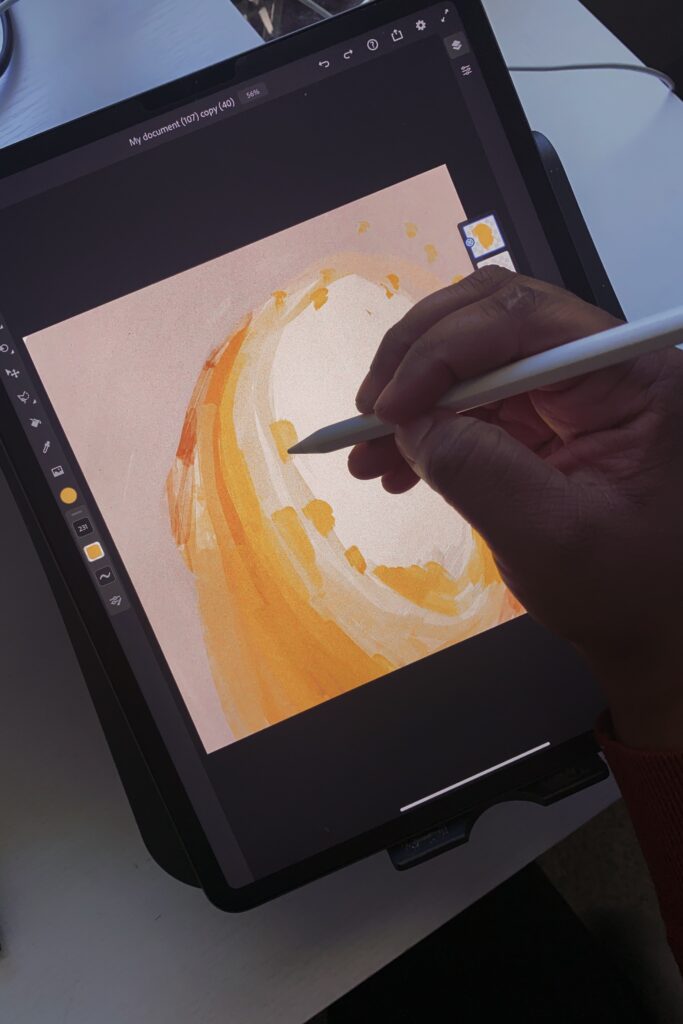
As Morgan began to get more comfortable sharing her words, which she now shared alongside the digital art she was creating, people started responding with comments like “Can you turn this into a sticker?”
At the time, the concept of putting her art on products wasn’t something Morgan was thinking about at all.
“I don’t think in terms of products,” she says. “I think it’s great when people can think that way, but that’s just not me. Growing up with a lemonade stand, I’m the one thinking ‘What does our poster look like? What does our table look like? How will the customers feel?’ If someone asked, ‘What are we gonna charge for the lemonade?’ I’d be the one saying, ‘I don’t know, make up something, I don’t care, give it away.”
At first, the sticker question confused Morgan. At the time, she didn’t have any idea how artwork like hers could become a product.
“Like, how could this be a sticker?” she remembers thinking. She really didn’t know. So she DM’d the sticker person and said, “What did you mean by that?” They shared a link to an Etsy shop with custom stickers. At that time, Morgan had never seen anything like that before. But she was willing to learn.
And she did. She created a sticker. And then people kept commenting on her work, asking for t-shirts and postcards and calendars—and that’s how her community helped build her shop.
“Almost any product that you have ever seen with my name on,” Morgan says, “was not my idea. That’s me listening to others. And thank you to everyone out there who sees things in my work before I see it.”
That shop is what eventually helped her out of the “tired and broke” phase that led to the 2016 breakdown, and to this day, the shop is still the core of her business.
“There are no metrics for that.”
In addition to product requests, Morgan’s followers also reached out asking for custom commissions. She laughs as she remembers charging $50 for her first custom piece for event invitations, knowing now how much she undercharged.
Then, brands like Coach started reaching out. Morgan’s initial thought was “I think you emailed the wrong person.” She can’t remember now exactly how much that project paid, only that it was “the exact amount that rent was.” That happened two years after her breakdown. “That’s when I started to realize,” she says, “maybe I should charge more than $50. And it grew from there.”
She still gets licensing deals from big brands, like Hallmark, but treats those like a lovely bonus, versus what she bases her whole business on. “I see those more like the weather,” she says. “My shop is kind of like the brick and mortar of the business, and those exciting partnerships are like having nice weather. When it’s there, it’s awesome. But you can’t live your whole life waiting for a perfect weather day.”
She says that while on the outside it might seem like she’s a big-time artist-slash-influencer with major brand deals, the reality is that her business is run much more like a local flower shop.
She often looks to local businesses for inspiration, which she says helps her focus on what she does well and how to best operate to serve her people directly.
Morgan still thinks of social media as a one-to-one experience versus one to many; instead of stepping onto a stadium stage to share artwork with millions, she thinks of it more as one curious person walking into a local shop as a tiny bell rings above the door.
Morgan often DMs new followers to ask how they found her. Often, the answer is that they heard about her through a friend.
“There are no metrics for that,” she says. She knows there’s usefulness in social media strategy, but for her, “that’s just not been my skill. I’m just focused on connecting with people.
“I don’t like telling people, ‘You just need to be consistent.’ If you’re someone who is creative, you are being consistent just by being you, just by existing and sitting with questions every day, twirling around ideas, or even having doubts. And if other people don’t see it every day, that doesn’t mean you’re not being consistent.
“When it comes to being consistent with social media, I have a very complicated relationship with that. I get what people are saying and I see how it’s been useful. But I don’t think of it as a habit of ‘I have to just keep showing up and hoping that these posts do well.’ Anytime I’ve tried that approach, it just has not been healthy and sustainable for me. Because as we know, the numbers fluctuate. It gets out of your control. There’s no way you can know what’s gonna ‘take off’ or not or what’s gonna lead to followers or not.”
She also sees the way work spreads online like “the weather” and doesn’t optimize for it. She prioritizes conversation over conversion, connection over clout. Instead of worrying about having the most people see her stuff, her main priority is to “focus on what I can do to just stay in conversation with people.”
And for Morgan that doesn’t necessarily mean sharing her creative work on social media.
Sometimes, she says, it’s the simple act of connecting with someone through an email or in person. She tries to remind herself that connection doesn’t only happen on the internet, and that typically the work that connects with people online comes from the inspiration she gathers offline.
When she does post, she tries not to judge her work by the numbers the platform provides. Instead, she asks herself, “Am I connecting with people? Am I making an impact?”
The platform numbers also aren’t always the best indicator of real connection or meaningful impact, she says. She’s had posts go viral with millions of views that don’t go anywhere beyond that. Whereas she’s had “low performing” posts that mean a lot to someone or capture the attention of a major brand who hires her because of it.
But sometimes, especially if work goes viral in any way, it can get lost in translation, “like playing telephone as a kid.”
“We’re still in such a new point in human history of having to interact with strangers online.”
“I absolutely am impacted by negative feedback,” Morgan says about the inevitable negative comments that come with being known online. “There have been times where people have said things and they’ve stuck with me for years.”
But there are some things she’s able to laugh off, that don’t affect her much at all.
She noticed that she’d respond to some negative comments but not others. Upon reflection, she realized she responded to the ones she felt most triggered by. And the more she unpacked those specific reasons with friends and in therapy, the more she was able to move comments out of the triggered category and into the brush-it-aside lane.
But it takes time, energy, and emotional work to do that. “I think it’s important to talk about,” she says, “because I do think there can be a little bit of toxic positivity around responding to negativity online, this idea that ‘Oh it’s not that big of a deal, it’s just a comment.’ I just don’t agree with that.
“We’re still in such a new point in human history of having to interact with strangers online with your vulnerable artwork. That is a big deal. I don’t care how small it is. I don’t care if it was just a thumbs down emoji.
“If it impacts you, you’re allowed to feel that. Whatever comes up for you, it’s so important you find people you can talk to about it and recognize that it is valid to have those feelings.”
Social media is also what helped Morgan finally get diagnosed as neurodivergent.
“The positive side of social media algorithms,” Morgan says, “is that sometimes they can become a space where you feel like it’s okay to express things. I was already following a lot of people who talked about mental health stigmas on TikTok. And then I started to get content about people getting ADHD and autism diagnosis as adults, especially women, and I was like ‘Whoa their experience sounds just like mine.’”
Years prior, Morgan asked her doctor if she could talk to someone about autism testing because she was starting to suspect she might be on the spectrum or that something was going on. Her doctor didn’t even look up when she asked. He dismissed her before she even finished her sentence saying, “There’s nothing wrong with you.”
She didn’t ask for help for three years, until she started seeing her same struggles reflected on TikTok by other adult women sharing their real stories and experiences (and who’d also been initially dismissed and then later diagnosed).
Sometimes an algorithm can become a tiny digital space where tenderness, doubt, and questions are welcome. But really of course it’s not an algorithm at all—it’s the people who decided to risk the rampant negativity online and share their story in hopes it helps someone else. It often does.
Morgan entered this virtual room and felt validated. She found a place where women were sharing their often-ignored experiences, empowering each other to speak up in areas where they’d once been silenced.
Morgan pursued diagnosis again and when she was diagnosed, it was liberating, finally giving her language for and confidence in areas that once felt like personal flaws or weaknesses. The diagnoses elucidated her strengths and gave her tools to amplify them without having to destroy (or heavily mask) herself in the process.
“I live in Georgia, and sometimes I want to do something really badly but it’s across the country, and I just can’t say yes,” she explains, referring to the ways her diagnosis has helped her make decisions. “It feels like a risk to say no because it’s actually a cool opportunity.
“Or sometimes it can be something happening locally in town that sounds awesome, but the day before I can’t say yes as much as I want to, even though it’s literally 30 minutes away. It’s taken some practice to get to that point.
“The 2016 version of me didn’t have that. It was like, okay, if you wanna do things out in the world, you’re gonna have to be everywhere, always, and you’re gonna have to show up on every platform and in person, online, everywhere, and do everything.
“I felt that pressure. It’s a risk to sit back and say, I’m not gonna sign up for that new platform, or I’m not going to try to show up at that thing even though I feel like I should. But what you gain is more energy and more fuel.
“If you see me out in public doing anything or see me showing my face on Instagram, there was a whole period before that where I had to get fully charged. I had to charge my social battery, my physiological battery, my emotional battery. It’s not on a whim.
“And that’s been hard because, depending on personality or someone’s neurological makeup, a lot of this stuff is a lot easier for a lot of people. Other people do find it easier to just show up at a random event or hop on a quick call, that kind of thing. For some people that stuff is just easy for them. It’s not for me.
“And that’s hard because we have a lot of social norms that make that seem like the ideal if you want to be successful. So I’ve had to let that go. I’m not gonna be able to do everything. I don’t know how people are gonna respond to that, but I do know that the energy I do preserve and the time I do take is just going to give me more energy to do the things I actually can do. And then when I am in those places, I can fully show up.”
When it comes to how the diagnoses have affected her art, Morgan says it’s made her even more unapologetic about who her art is for and who it isn’t. “I had someone make a video making fun of my art. And I thought, ‘yes someone with that worldview is just not gonna get it. It didn’t even bother me. They hadn’t lived what I’ve lived or lost what I’ve lost. I would actually be surprised if they got it. I feel like ‘Yeah, this is not for you.’
“Some people really can’t stand art that has words on it. So I’m like well they’re not going to like what I like. Ten-years-ago me wouldn’t have known what to do with that; I wasn’t willing to face that. But now I’ve lived through enough of it to know that there are people who won’t be into what you’re doing, but that only serves to give you more information about who your people actually are. Because if there are people who don’t like it, then there’s also probably people that really do.”
“It feels like heartbreak.”
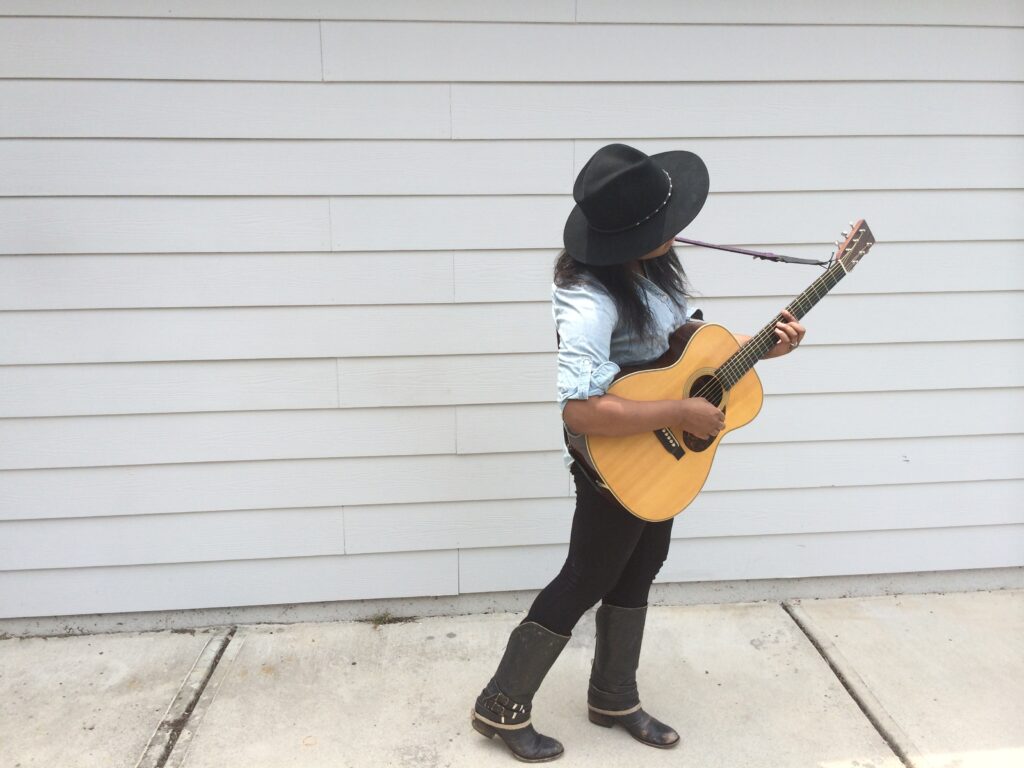
While Morgan’s work is known and shared by millions now, she still remembers what it felt like to have no one paying attention, especially during her early career in music.
She recalls the deep ache of releasing an album and then feeling like nothing happened. “It feels like heartbreak,” she says. “A breakup, a loss.
“It’s hard when something you worked really hard on and put out there doesn’t do the numbers it’s supposed to do; you just feel like you failed. And then there’s the financial part. Like, man I spent a lot of money on that. I spent a lot of time on that. That’s hard. And I don’t think that ever really goes away.
“But I try to see all my projects as interconnected and informing one another. So if there’s a book, album, or project that didn’t quite do what I thought it was going to do, I can still see how the work I put in can apply to other work.
“Even if the album didn’t win awards or didn’t chart, I’m only able to work on the new thing because of what I learned in the old thing.
“The world needs the form of ‘this is an album’ or ‘this is a book’ but the consistent thread through all of that is me having worked on all of it; I don’t have to divide myself up like that.”
To help her sustain the ups and downs of the creative life, Morgan recently enrolled in a PhD program.
“A lot of this work can become very isolating at times,” she says, “and it can be hard for someone who is not an extrovert and who is neurodivergent. My default when feeling isolated isn’t to socialize more. Like, I just should have a dinner party? No, please don’t make me do that.
“I’m pouring so much out, like where can I go where I can be poured into?”
She wanted a place where she could be with people in person, find mentors and peers, and grow artistically.
“Not everyone has to go back to school,” she says, “but I do think it’s important that you have places that you’re poured into that can challenge you to go deeper in what you’re doing. And for me, school is that right now.”
Being in school also inspired her to host her very first in-person writing workshop last summer. “It took me years to work up the courage to do that,” she says,” because that is not my default setting. My default setting is hermit mode at my house.”
She loves to teach. She’d just rather do it behind a wall, love-is-blind style.
But she wanted to challenge herself, the same impulse that made her return to school.
Before the workshop started, she was nervous and anxious, all of the doubt swirling in: “Why did I do this? What if I don’t deliver? What if people feel like it’s a waste of their time?”
She didn’t sleep well the night before.
But when she walked up to the front and started teaching, she says, “I was suddenly so excited to meet everyone and I was reminded these are people who chose to come. I didn’t set up chairs in the middle of the New York subway forcing people to come to my workshop. They chose to be here and are going to want to get something out of it. But more than that, they want to connect with you. That’s why they did that. That helped me relax into myself and live out all that I had prepared.”
Morgan is excited about what she’s learning now and how it will show up later in her work, but mostly she’s relishing in the not knowing, in the going slow.
“In the research world it’s encouraged to take your time,” she says. “You don’t have to rush things. I’ve needed that because I’ve been so in the product world where the timelines are really tight. It’s nice to have a slower pace where it’s normalized to work on a project for years before people see it.”
She doesn’t know what’s coming next, but she doesn’t mind, savoring the hope and possibilities offered to those who are willing to sit for longer than most in the place of “I don’t fully know what this is yet”—that empty notebook place.
A place for play, not perfection.
“I will oftentimes start a creative session by doing something that is intentionally a mistake,” Morgan says of her art practice. “If I’m writing on a physical page in a pretty notebook, I will sometimes just draw nonsense on the front page to tell myself, ‘This is not a perfection space. This is not a performance space. You just need to get the stuff out first.’ If I’m playing piano, sometimes I will literally just run my hand across all the keys, just to create dissonance.”
*
If you enjoyed this profile, please support Morgan by visiting her shop or following her on Instagram. You can also learn more about her on her website.


The Little Book of Big Dreams is filled with true stories of dreamers who decided to try for their biggest dreams and kept going when things got hard (which they almost always do).
The dreamers in this book include Oscar winner Kristen Anderson-Lopez, Disney producer Don Hahn, Pensole Lewis College founder D’Wayne Edwards, Hamilton cast member Seth Stewart, Black Girls Code founder Kimberly Bryant, and more.
But the most important story in this book is yours.
The Little Book of Big Dreams: True Stories about People Who Followed a Spark
ORDER THE LITTLE BOOK OF BIG DREAMS
SPARK YOUR NEXT DREAM

© Chronicle | Legal | Site Credit |